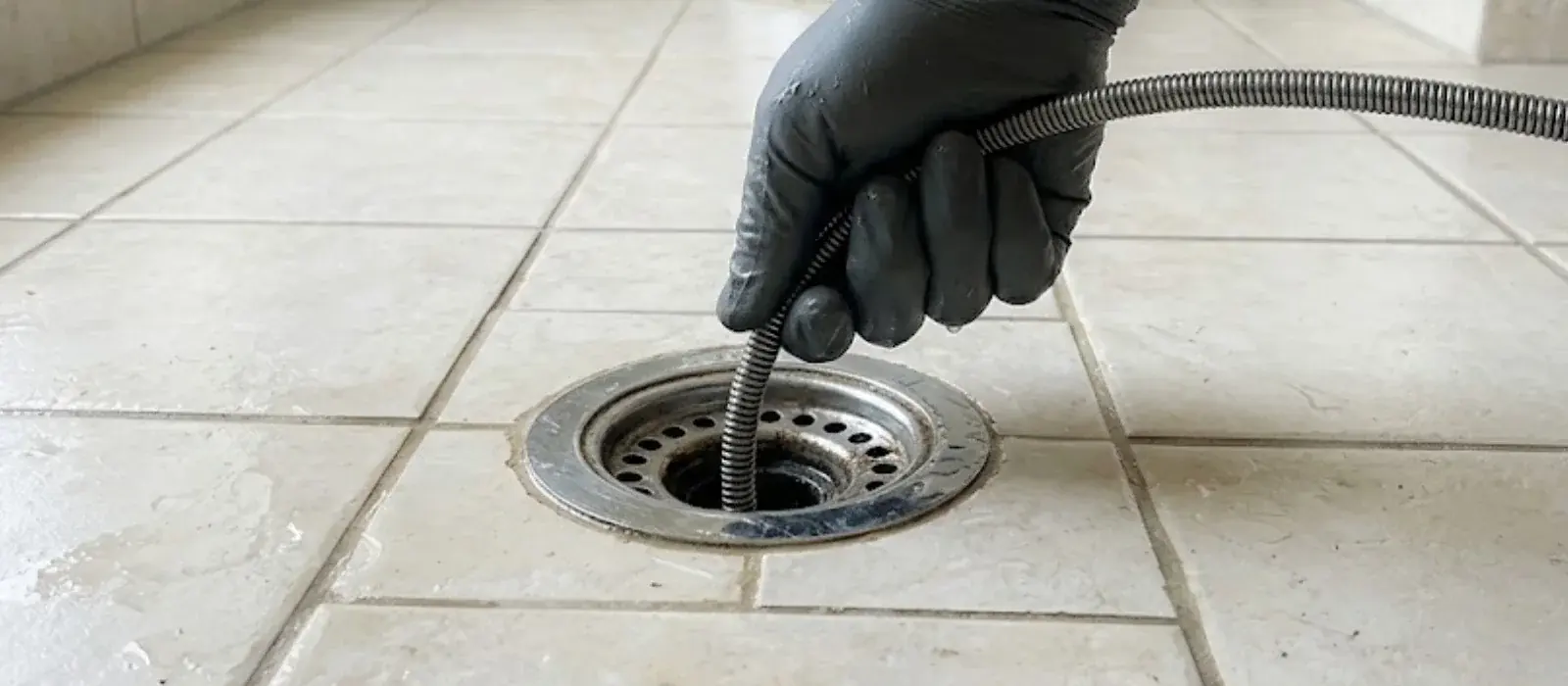
One drain or the whole house?
The first question is where it clogs. A single sink that backs up usually has a local blockage in the trap or branch line. Several fixtures backing up together points to the main. The pattern tells you whether the problem is a fixture, a branch or the sewer.
Try this. Run the sink with the tub drain closed. If water gurgles up in the tub, the lines are connected and the blockage is downstream of both. Stop using water and call.
| Pattern | Likely location | Right fix |
|---|---|---|
| One sink slow, others fine | Trap or branch | Drain cleaning |
| Tub and sink both slow | Shared branch | Cable the branch |
| Toilet gurgles when washer drains | Main line | Sewer line cleaning |
| Same drain clogs every month | Wall buildup or a defect | Jetting or camera inspection |
Why it comes back
A cable opens a hole through a clog. The grease, hair and soap film on the pipe wall stay where they are. A few weeks later the new buildup closes the hole and the cycle repeats. People call this "it came right back," and the fix is to clean the wall, not just open the center.
The other cause is a defect: a pipe that sags, an offset joint, a root entering at a seam or a crack that traps debris. No amount of cleaning cures those. A camera shows which one you have, and our sewer camera inspection page explains what you get to see.
Common causes at home
What clogs drains in most houses
- Kitchen grease that cools and coats the pipe wall.
- Hair and soap in bathroom drains.
- Wipes sold as flushable that do not break down.
- Roots entering older lines through small cracks.
- Scale and corrosion inside old iron pipe.
What to try, and what not to
A plunger and a drain strainer cover the simple cases. Skip chemical drain cleaners. They can damage pipes, they are hazardous if you later need to cable the line, and they rarely clear what is actually causing the repeat. If you have a garbage disposal, chemicals are an especially poor idea, as our garbage disposal repair page explains.
When jetting makes sense
Hydro jetting scours the whole inside of the pipe, which is why it suits repeat clogs from grease and scale. It is not for a pipe that is cracked or collapsed. We run a camera before and after when the situation allows. See hydro jetting for details.
Cost factors for clearing a repeat clog
Location of the clog
A fixture trap is quicker than a main line.
Access
A clean outdoor cleanout shortens the job.
Method
Cable, jetting or both are priced differently.
Camera work
Inspection is a line item you can accept or skip.
For your real number, call (770) 214-4545.
Same drain, third time?
Call and tell the dispatcher how often it has clogged. That points us to the right tool.
What a plumber looks for on the first visit
The first minutes tell a plumber a great deal. Which fixtures are slow? Does water gurgle in a neighbor fixture when one drains? Does the problem follow a pattern, such as the morning shower or the dishwasher cycle? These clues separate a local trap problem from a branch or main line problem before any tool comes out.
Then comes the tool choice. A small cable handles a hair clog in a tub. A larger powered cable cuts roots in a main. A jetter cleans the wall. A camera shows what the others cannot. Using the wrong tool is how a drain gets "fixed" three times in one year.
Habits that keep drains open
A short routine that works
- Use a hair catcher in every tub and shower drain.
- Wipe greasy pans with a paper towel before washing them.
- Flush only toilet paper and human waste, and put wipes in the trash.
- Run hot water for a minute after the dishwasher drains.
- Learn where the cleanout is and keep the cap accessible.
When to stop and call
Repeated clogs in the same place, sewage smells, gurgling in several fixtures and wet patches in the yard are not signs to try another bottle of chemicals. They are signs of a problem that needs a camera. A plumber who shows you the footage and explains it in plain terms is giving you the information you need to decide, whether the answer is maintenance or a repair.
If you are comparing options, ask what each costs in disruption as well as money. A cable visit is short and low impact. Jetting takes longer and needs good access. A repair may involve digging. Knowing the range helps you plan.
Quick reference for repeat clogs
Note which fixtures are slow and how often it happens. Skip chemical cleaners. Use a strainer. If the problem returns within weeks of a cleaning, ask for a camera look. If sewage appears in the lowest drain, stop using water and call. If the problem is one sink only, a trap or branch cleaning is usually enough.
Tell the plumber what has been tried, because it saves time and avoids repeating the same fix.
Sources and standards
Drain, trap and cleanout requirements follow the International Plumbing Code (IPC) as adopted in Georgia. Methods such as cabling, jetting and camera inspection are standard trade practice.
Local note: where the pipe goes after your house
In Tucker and the DeKalb County towns we serve, such as Stone Mountain and Clarkston, the county handles the mains and the private lateral is yours. A clog that repeats after a thorough cleaning may be at the connection, which is why a camera that tracks distance is useful.
If the camera places the blockage on the public side, we document it and tell you whom to call, so you do not pay for the utility's problem.
Questions we hear from homeowners
It depends on the line. A drain with heavy grease may need yearly attention. Others never need it until a problem shows.
It can be, or it can be a dry trap. Run water in the fixture first, since an unused trap loses its seal.
Yes. Roots enter through small cracks or loose joints and form a mat. A camera confirms them.
Only if the blockage is in the shared main. Your private line affects only your house.
For a single soft clog, yes. For repeat clogs, jetting or repair is usually needed.