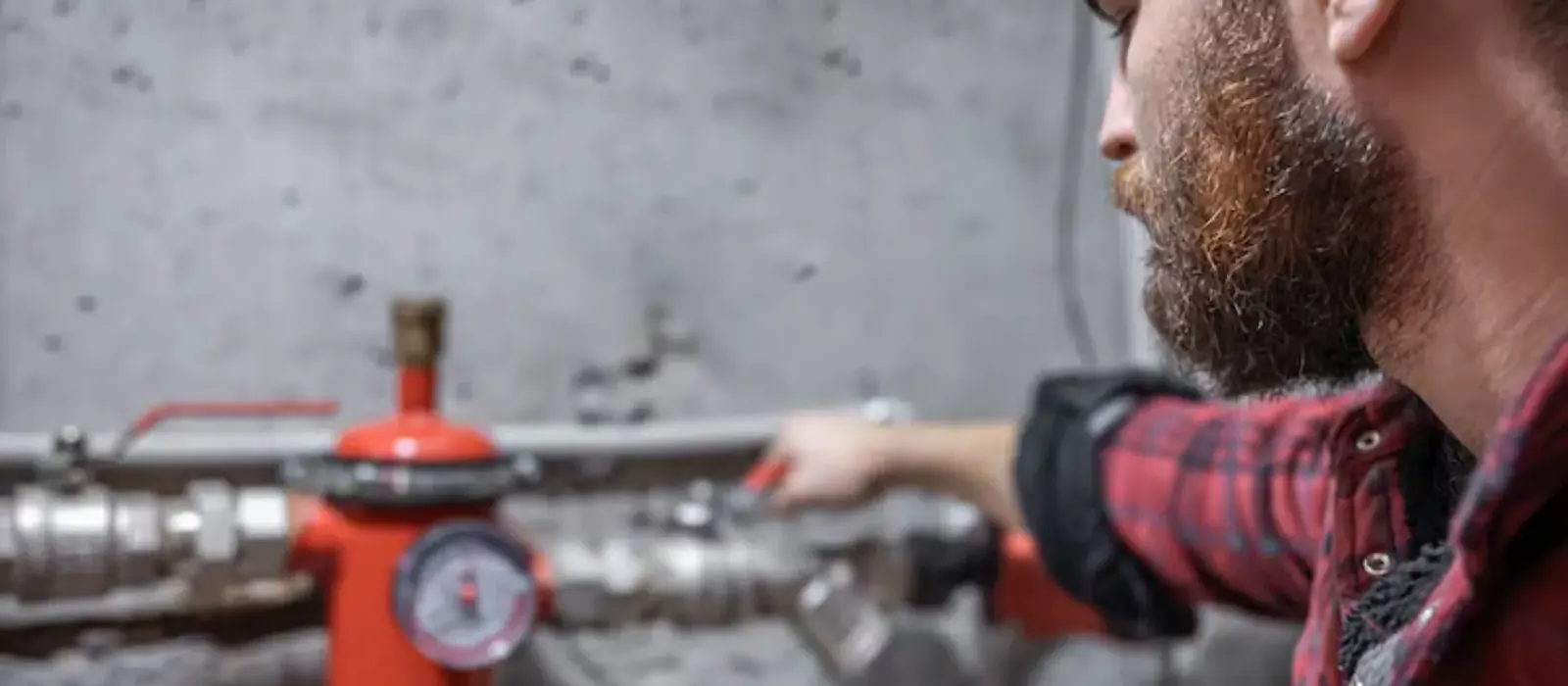
Where the main shutoff usually is
There are two valves to know. The first is at the house, usually where the water line enters, in a utility room, garage, crawlspace or basement, or on an exterior wall. The second is at the meter box near the street, which the utility controls.
If you have a slab foundation, the house valve is often in a closet, a garage wall or near the water heater. Look for a wheel handle or a lever on a pipe about as thick as your thumb or wider.
| Valve type | How it looks | How to close it |
|---|---|---|
| Ball valve | Lever handle | Turn a quarter turn so the lever is across the pipe |
| Gate valve | Round wheel | Turn clockwise until it stops |
| Meter valve | Flat tab in the meter box | Use a meter key, or call us |
Test it once a year
Close the valve, open a faucet to confirm the water stops, then open the valve again. If it is stiff, leaks at the stem or will not close fully, it should be replaced. Old gate valves often seize, and a valve that cannot be closed in an emergency is not a valve. A replacement is a short job we describe on our plumbing installation page.
Fixture shutoffs too
Each toilet and sink has its own small shutoff, called an angle stop or supply stop. In a small leak these let you shut off one fixture without losing water to the house. Turn them clockwise to close. If they are crusty or stuck, do not force them. A stuck stop can snap, so call for a replacement. This is a common job in faucet repair visits.
Label it and tell the family
- Hang a tag on the main valve with the open and closed directions.
- Take a photo and keep it on your phone.
- Show every adult and older child where it is.
- Keep a meter key in the garage if your meter box has a valve you may need.
If the valve will not move
Do not use a pipe wrench to force a stuck valve. You can break the stem. Try a gentle back and forth motion, and if it still resists, close the meter valve or call us. If the house main is the problem, we can replace it, and in some cases the utility must be notified to shut off the street side.
After you shut it off
Open a faucet at the lowest level to drain the pipes, and a high one to let air in. Switch the water heater to pilot or off, since a heater with no water can overheat or be damaged. Turn the valve back on slowly later and check for leaks.
Then call. Closing the valve stops the damage but does not fix anything.
Valve type
Ball valves are more reliable than old gate valves.
Location
An accessible valve is quicker to swap.
Pipe material
Fittings differ for copper and plastic.
Water outage
The house loses water briefly during the swap.
For your real number, call (770) 214-4545.
Valve stuck or leaking?
Call and we can replace it with a reliable ball valve.
Walk the house in ten minutes
Start at the meter
Find the meter box near the street and note where the line runs toward the house.
Follow the line
Go to the nearest wall or slab edge in that direction and look for a pipe entering the house.
Check the likely rooms
Look in the garage, the utility closet, the crawlspace access and the water heater area.
Identify the valve
Find the handle or lever and note whether it is a wheel or a lever type.
Mark and photograph
Label it and add a photo to your phone with a note about which way closes it.
Mistakes that make emergencies worse
- Never testing the valve, then finding it frozen in place when water is flowing.
- Forcing a stuck valve with a wrench and breaking the stem.
- Closing the valve and forgetting to open a low faucet to drain pressure.
- Leaving the water heater on with the water off, which can overheat the tank.
- Not telling the rest of the household where it is.
Replace a bad valve before you need it
A gate valve that has not been turned in years often fails when asked to. The internal wedge corrodes, the stem seizes or the packing leaks. A ball valve closes with a quarter turn and rarely sticks.
Replacing the house main is a short job, but it needs the street side shut off first. That is a reason to schedule it during daytime hours, when the utility can be coordinated, and not at midnight with water on the floor. If you discover yours is stiff, treat it as a small project to book, not a problem to ignore.
Quick reference for an emergency
Go to the valve. Turn it fully to closed. Open a low faucet. Turn off the water heater. Call. When the repair is done, open the valve slowly and check for leaks. If the valve will not close, go to the meter shutoff or call the line and we will walk you through it.
Make sure everyone in the household can do this. A teenager home alone should know how.
Sources and standards
Valve and supply work follows the International Plumbing Code (IPC). For the street side, follow your utility's rules about who may operate the meter valve.
Local note: meter boxes in Tucker
In Tucker and the DeKalb towns like Stone Mountain and Clarkston, the meter belongs to DeKalb County Watershed Management. The meter lid is usually flush with the ground near the street, and the utility may not want residents operating its side of the valve.
Your own house valve is the one to learn. If you cannot locate it, call us and we find it and tag it during a visit.
Questions we hear from homeowners
Often near the water heater, in a closet, in the garage or on an exterior wall where the line enters.
Close the meter valve at the street, or call us and we guide you.
Yes, and it is advised when the water is off. Turn the heater to pilot or off.
Once a year is plenty.
Possibly, but the main line must be shut off at the meter first. Many people prefer to have it done.