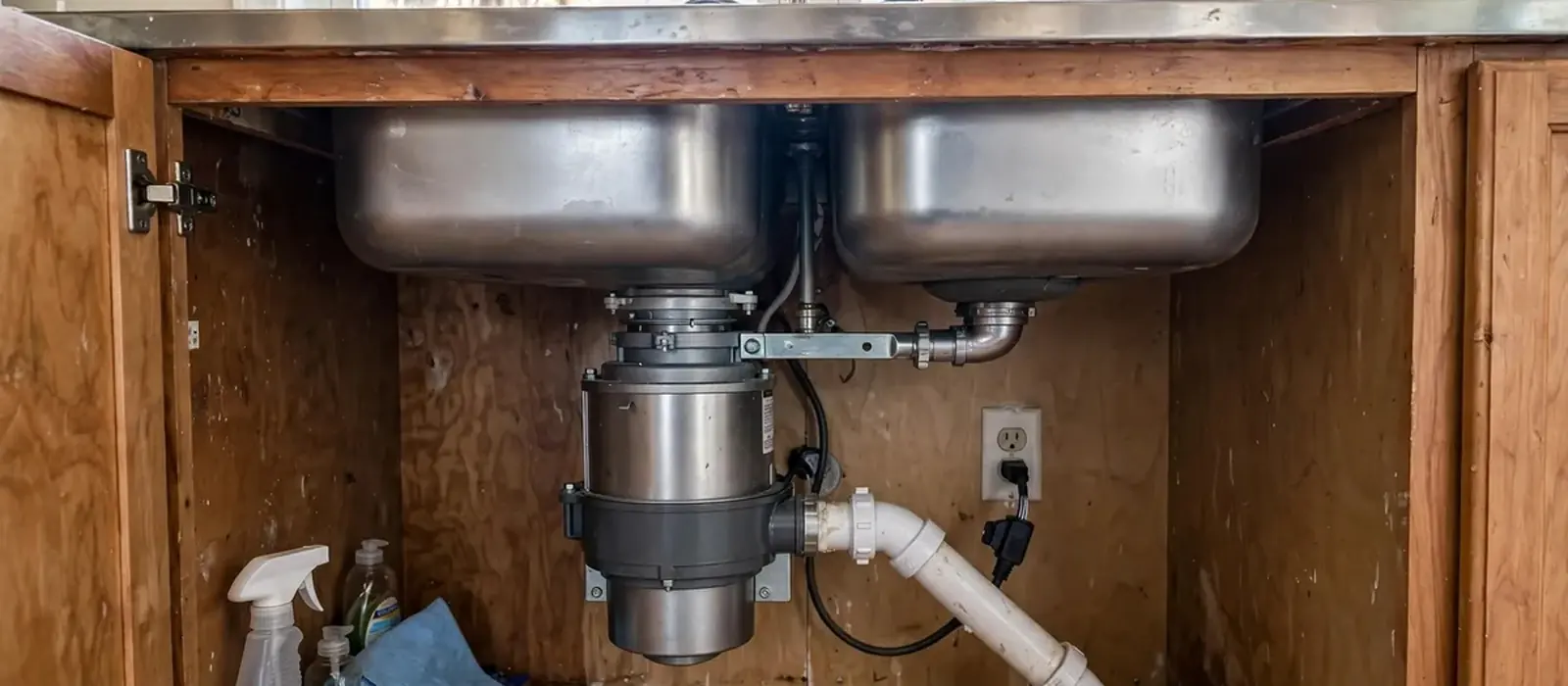
Step by step, safely
Switch it off
Turn the wall switch off, and for extra safety turn off the breaker or unplug the unit under the sink.
Look with a flashlight
Use tongs or pliers to remove anything visible. Never use your hand.
Turn the plate by hand
Insert a hex key into the socket at the bottom of the unit and work it back and forth until it turns freely.
Press reset
Push the red button on the bottom of the unit.
Test with water
Turn on cold water, restore power and switch the unit on.
| Sign | Meaning | Action |
|---|---|---|
| Hums, will not spin | Jam | Free with the hex key |
| Silent | Tripped reset or power issue | Press reset, check the breaker |
| Spins but sink drains slowly | Clog beyond the unit | Drain cleaning |
| Leak at the top | Failed flange seal | Reseat the flange |
| Leak from the bottom | Cracked housing | Replace the unit |
What not to put down a disposal
Keep these out
- Grease, oil and fat, which coat the pipe beyond the unit.
- Coffee grounds in bulk, eggshell membranes and pasta or rice that swell.
- Fibrous vegetables like celery and corn husks in large amounts.
- Bones, fruit pits and hard shells.
- Non-food items such as bottle caps or utensils.
Smells and slow drains
A smell usually means food residue on the splash guard or in the drain. Clean the rubber guard with a brush and dish soap, run cold water and grind a few ice cubes. A slow drain with a healthy disposal points to a clog in the trap or the line. Chemical drain cleaners are a poor idea here. They can damage the unit and make later cleaning hazardous.
Leaks mean replacement, mostly
A leak at the top or at a hose connection can be repaired. A leak from the bottom of the housing means the internal seal or the shell has failed, and the motor will follow. Replacement is a short job. We connect the drain and the dishwasher line and wire it to the existing outlet. If new electrical work is needed, that is a job for an electrician, and we tell you so.
Tied to the faucet and trap
While the cabinet is open, check the trap and the faucet connections. A drip above the disposal can look like a disposal leak. If the faucet is the source, see faucet repair.
Repair or replace
A jam release is short, a replacement includes the unit.
Unit size
Larger motors cost more.
Electrical
Missing outlet or switch is separate.
Drain condition
A bad trap adds parts.
For your real number, call (770) 214-4545.
Disposal still stuck?
Call and we can free or replace it, often the same day.
Why disposals jam
The grinding plate spins and flings food against the chamber wall. Something hard, fibrous or too large wedges between the plate and the wall, and the motor stalls. The motor hums because it is getting power but cannot turn.
Prevention is simple. Feed small amounts with cold water running. Cut up large scraps. Skip the items on the list above. A disposal is not a trash can, and treating it as one shortens its life.
Choosing a replacement
| Feature | What it means | Who it suits |
|---|---|---|
| Motor size | More power grinds tougher food | Large households and heavy cooks |
| Continuous feed | Runs while a switch is on | Most homes |
| Batch feed | Runs only with the stopper in place | Homes with young children |
| Sound insulation | Dampens noise | Open kitchens |
| Mounting style | Must match the sink flange | Replacements need a match |
What installation involves
The old unit is disconnected from the drain, the dishwasher hose and the power. The mount is released, the new mount is seated with plumber's putty or a gasket, and the unit is hung and connected. The knockout plug on the dishwasher inlet is removed if a dishwasher is attached. Water is run and the connections are checked for leaks. The job is usually done within a visit.
Noises and what they tell you
- A rattle usually means a spoon, bottle cap or other hard item is in the chamber.
- A grinding sound with no food can mean worn parts or a loose mount.
- A high whine can mean the motor is spinning but the plate is not.
- A loud clunk at start-up may be a stuck object freed by the plate.
- Silence after a click suggests a tripped overload or a power fault.
Keeping the sink drain healthy
The disposal is only the first step in the drain. The pipe under the sink carries the ground waste to the main line, and grease coats it over time. Run hot water after use, avoid putting grease in the unit and have the line cleaned if the sink drains slowly. A slow drain is a signal long before it is a clog.
If you are replacing the unit anyway, ask the plumber to inspect the trap and the drain pipe. New parts on a crusty old drain bring the old problem along with them.
Quick reference for a jam
Off at the switch, off at the breaker, flashlight and tongs, hex key at the bottom of the unit, reset button, cold water, switch on. If it does not spin after two tries, stop. A motor that trips again and again has a mechanical or electrical fault, and repeated resets can burn it out.
If the unit is more than a decade old and now jams often, a replacement may cost about as much as repeated visits. We can tell you which makes sense.
Sources and standards
Drain, trap and venting connections follow the International Plumbing Code (IPC). Always follow the disposal manufacturer's manual for reset and hex key steps, since models differ.
Local note: apartments and shared kitchens
In dense housing like Clarkston, one disposal feeds a shared stack, so a grease habit upstairs can back up a unit below. If your disposal runs fine but the sink drains slowly, the shared line may be the culprit and the property manager should know.
In single-family areas like Lilburn, the same habits affect only your own line, which makes cleaning easier.
Questions we hear from homeowners
Never. Even when off, use tongs. The risk is real.
The motor is trying to turn a jammed plate.
No. Cold water should run while grinding and for a few seconds after.
Many last several years, depending on use and what goes in.
Ice helps clean the chamber, but the grinders are not blades in the usual sense.